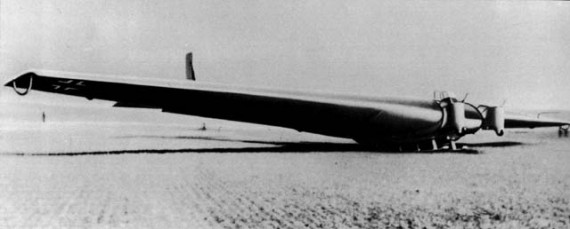
The Junkers Ju 322 Mammut (Mammoth) was a heavy transport military glider, resembling a giant flying wing, proposed for use by the Luftwaffe in World War II. Only two prototypes were ever built.
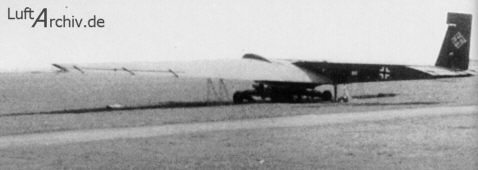
Designed in late 1940 by Junkers as the Junkers EF 94, the Ju 322 was to fulfill the same role as the Me 321 Gigantheavy transport glider. Fulfilling a requirement to be built out of non-strategic materials, using all-wooden construction, the Ju322 was to be able to carry 20,000 kg of cargo, equivalent to either a Pz.Kpfw.IV, a Flak 88, a Half-Track or aself propelled gun, including attendant personnel, ammunition and fuel. The cargo door was located in the centre section of the leading edge of the wing, with the cockpit offset to the port side above the cargo bay. The glider's tail extended from the centre section, and had a typical arrangement of stabilizing fins and vertical rudder. Armament for production gliders would have consisted of three turrets, each housing a single manned MG 15 machine gun.
During construction of the first prototype (Ju 322 V1), problems were encountered with building an all-wooden glider as Junkers did not have the expertise in the use of such materials. A test with a battle tank compacted the loading floor, leading to redesign, further reducing the payload. Consequently the planned payload weight for the Ju 322 was reduced to 16,000 kg, and later to 11,000 kg.[1] The Ju 322 V1 made its maiden flight in April 1941, towed by a Junkers Ju 90. The test flight was largely successful after the Ju 90 had managed, with some effort, to tow the glider off the ground before running out of runway. However, the Ju 322 quickly gained height above the Ju 90 and so pulled the towplane's tail up and prevented it from climbing and releasing the tow cable at the right height. The glider was also highly unstable under tow but, after being released, it stabilised but landed in a field from which it took two weeks to be towed back to the launch airfield by tanks. Although design improvements were planned for the Ju 322, the RLM ordered the Ju 322 project dropped in May 1941, considering it an inherently poor design.
Following the cancellation of the project, the Ju 322 V1 completed a few more test flights, but was cut up for fuel along with the Ju 322 V2 and 98 partially completed gliders.
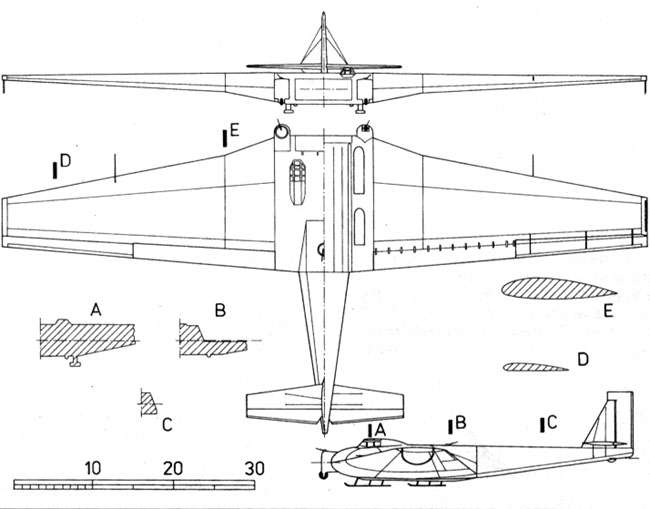
General characteristics
- Crew: 1
- Payload: 11,000 kg(22,000 lb.) (24,255 lb)
- Length: 30.25 m (99 ft 3 in)
- Wingspan: 62 m (203 ft 5 in)
- Height: ()
- Wing area: 925 m² (9,952 sq ft)
- Useful load: 11,000 kg (24,255 lb)
- During construction of the first prototype (Ju 322 V1), problems were encountered with building an all-wooden glider as Junkers did not have the expertise in the use of such materials. A test with a battle tank compacted the loading floor, leading to redesign, further reducing the payload. Consequently the planned payload weight for the Ju 322 was reduced to 16,000 kg, and later to 11,000 kg.[1] The Ju 322 V1 made its maiden flight in April 1941, towed by a Junkers Ju 90. The test flight was largely successful after the Ju 90 had managed, with some effort, to tow the glider off the ground before running out of runway. However, the Ju 322 quickly gained height above the Ju 90 and so pulled the towplane's tail up and prevented it from climbing and releasing the tow cable at the right height. The glider was also highly unstable under tow but, after being released, it stabilised but landed in a field from which it took two weeks to be towed back to the launch airfield by tanks. Although design improvements were planned for the Ju 322, the RLM ordered the Ju 322 project dropped in May 1941, considering it an inherently poor design.
- Following the cancellation of the project, the Ju 322 V1 completed a few more test flights, but was cut up for fuel along with the Ju 322 V2 and 98 partially completed gliders.
Comments